
Meet the nutria neighbors
FIELD NOTE
January 27, 2026—Kerrville, Texas
Before our cold front arrived, I spent an afternoon on the G Street trailhead. I usually end up lured off the trail by something and this time it was Northern Cardinals playing in the reeds. While shooting a bright male movement caught my eye and just across a small pool was my first nutria. I’m a transplant to the area and haven’t seen nutria before. I keep hearing rumor of a beaver in the area—closer to the Francisco Lemos Bridge—so that was my first thought.
If you’ve ever seen a nutria, they have the big square teeth and—a little startling—they’re a pretty bright orange. So I’m thinking, “Is this another beaver?” and taking photos as quickly as I can. For my photog friends, I shoot with a Canon EOS R6 Mark II mirrorless and my favorite lens, a Sigma telephoto 150-600 mm F/5-6.3 DG Ø95.
As more of the furry body emerged, I could see the tail, which definitely wasn’t a beaver tail, and I figured it out. This was a nutria! I was so focused on trying to get a few clear pictures as the critter fled to the safety of a small burrow, I failed to notice the nutria pup trailing Mom until editing pics later.
I noticed she turned within the hollow to watch me but figured she was wondering about the weird lady watching her. Later, I could see she tucked the baby behind her. Then, the moment I glanced down, they slipped into the murky water.
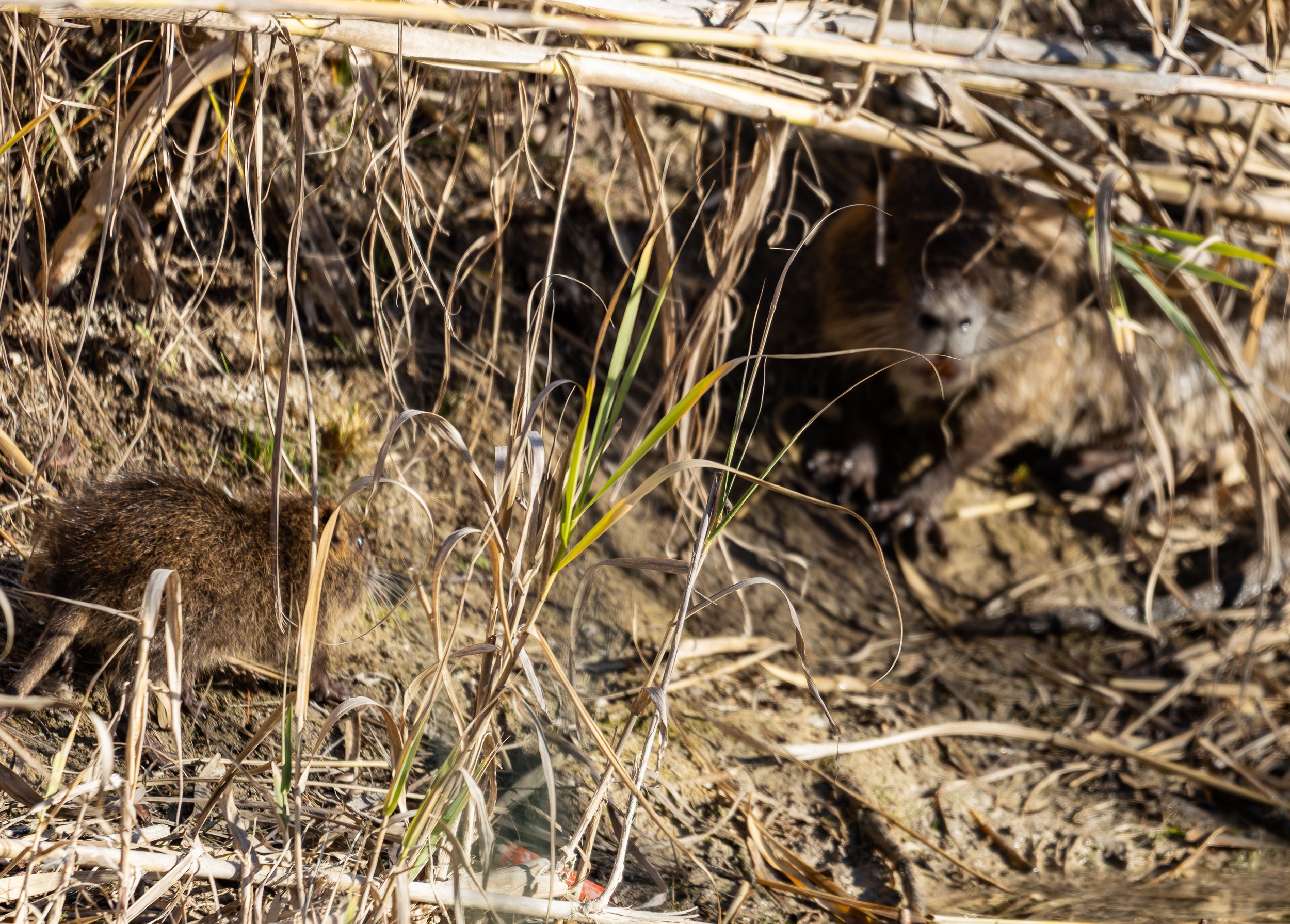
The nutria pup following Mom into the burrow.
About the nutria
In North America, we use the name nutria. as do people in Asia and Central and Eastern Europe. However, in Spanish-speaking countries, the word nutria usually means otter, so in South America and Britain and other parts of Europe, they use the name coypu or coipo. In Dutch, they’re referred to as beverrat, meaning beaver-rat, or my personal favorite, in German, many call them sumpfbiber, or swamp-beaver.
The swamp-beaver likes a semiaquatic lifestyle, with favored habitats in swamps, marshes, and along shores of rivers and lakes. According to Texas Tech, they can live in salt and freshwater.
They burrow but not deeply and make nests of reeds and sedges built into piles, similar to swans’ nests. Some burrows are also under roots of trees exposed along river or stream banks.
Nutria eat mainly aquatic and semiaquatic vegetation but can also feed on shellfish. They like cattails, reeds, and sedges, and have also been known to enjoy cabbage, carrots, and sweet potatoes.
They can breed any time of year. The gestation period is 127-132 days and litters can range from 2-11 (good grief), but the average is about 5.
In 1792, Robert Kerr—no affiliation to Kerr County—assigned nutria the genus of myocastor, the etimological history of which is essentially two Greek words that mean mouse-beaver. Kerr was a Scottish surgeon and writer on science and history.
An average adult nutria body is about about 2.5-3 feet long, plus a 12-16 inch tail, for a total of 4-4.5 feet. Typical weight is 17-23 pounds.
Here’s the classification information:
Order: Rodentia
Family: Echimyidae
Genus: Myocastor
Species: M. Coypus
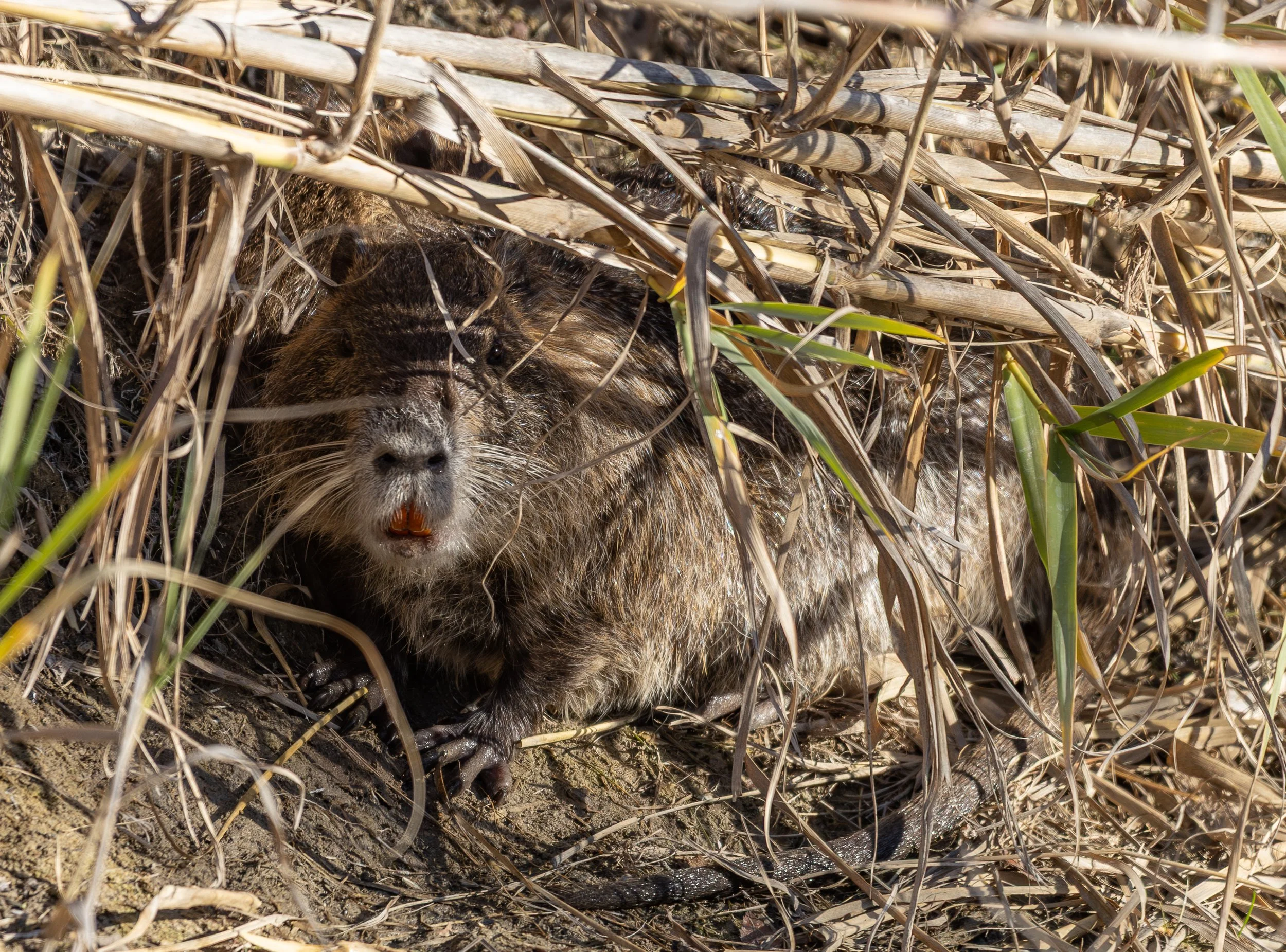
The nutria hides in her shallow burrow with her pup tucked up behind her head.
Texas nutria history
I did a little dive into their history in the area. According to Texas Parks and Wildlife, nutria were imported to the U.S. from South America in the late 1930s for their fur. Texas and Louisiana were among the states that established farms. When the market crashed in the 1940s, maintaining the farms was too expensive and many ranchers just release their nutria into the wild.
Texas Tech adds that in Texas, nutria were also widely thought to be a cure-all for ponds choked with vegetation, so many were used for that purpose. However, while they eat many types of aquatic plants, they don’t eat algae or some submerged plants, so they weren’t the cure-all imagined. Plus, their ability to reproduce rapidly quickly introduced an overpopulation problem. Like the fur-traders, many just released them into the wild.
I don’t know what the population here was like before the flood in July but I’ve never seen one until this sighting. That said, I wouldn’t have been able to access this area in the past, so they could have been happily reproducing in privacy. In any case, even with the scary teeth, it was cute. And that pup. Hopefully, they don’t become an issue here that requires any sort of action.
A final fun fact: A group of nutria are referred to as a colony.
I’ll find that beaver eventually …
